
Local Rare Wildlife and Plant Species
Candia is home to many different wildlife and plant species. This page contains information about some of the more rare species found in our area.
Blanding's Turtle
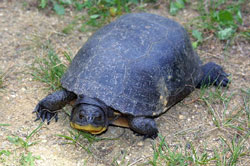 Description: The Blanding's turtle is a medium
sized turtle with an average shell length of approximately
7-9 inches and a maximum length of 10 inches. A distinguishing
feature of this turtle is the bright yellow chin and throat.
The carapace, or upper shell, is domed, but slightly flattened
along the midline, and is oblong when viewed from above. The
carapace is speckled with numerous yellow or light-colored
flecks or streaks on a dark background. The plastron, or lower
shell, is yellow with dark blotches symmetrically arranged.
The head and legs are dark, and usually speckled or mottled
with yellow. The Blanding's turtle is also called the "semi-box"
turtle, for although the plastron is hinged, the plastral lobes
do not shut as tight as the box turtle's.
Description: The Blanding's turtle is a medium
sized turtle with an average shell length of approximately
7-9 inches and a maximum length of 10 inches. A distinguishing
feature of this turtle is the bright yellow chin and throat.
The carapace, or upper shell, is domed, but slightly flattened
along the midline, and is oblong when viewed from above. The
carapace is speckled with numerous yellow or light-colored
flecks or streaks on a dark background. The plastron, or lower
shell, is yellow with dark blotches symmetrically arranged.
The head and legs are dark, and usually speckled or mottled
with yellow. The Blanding's turtle is also called the "semi-box"
turtle, for although the plastron is hinged, the plastral lobes
do not shut as tight as the box turtle's.
Life History: Mating probably occurs in April and early May with nesting beginning in early June and lasting throughout the month. The clutch size varies from region to region. The Blanding's is a timid turtle and may plunge into water and remain on the bottom for hours when alarmed. If away from water, the turtle will close itself up within its shell. It is very gentle and rarely attempts to bite. It is very agile and a good swimmer. The Blanding's turtle overwinters under or near water, in mud or under vegetation or debris. During the nesting season, a female Blanding's turtle may be found more than a kilometer from where it hibernated. It is omnivorous, eating crustaceans and other invertebrates, fish, plants, carrion and vegetable debris. It is capable of catching live fish. Blanding's turtles take 18-22 years to reach sexual maturity and may live to be 70 years old.
Habitat Associations: Variety of wetland systems including rivers, beaver flowages and isolate pools. Large marshes with blueberry and button bush cover may be preferred. Nests in natural areas with loose soil such as beaver lodges, lakeshore beaches and soil-filled cracks in bedrock and in sandy substrates created by human activity such as gravel pits and roadside edges.
Protection Strategy: The goal is to increase survival by reducing the risks created by people. The first line of defense is to find relatively pristine areas that provide quality habitat where these species are found and take measures to protect them so these turtles can continue to thrive there. The second strategy, in areas where these turtles exist but development has created increased vulnerability, is to attempt to reduce the risks they encounter by increasing people’s awareness.
- Maintain roadless areas especially in association with wetland complexes. Avoid upgrading or adding road systems that will bisect wetland complexes.
- If a road is built over a wetland or stream, build a bridge instead of installing a culvert.
- Maintain a buffer around streams and wetlands, Provide natural buffers around stream and river systems where they connect wetland complexes.
- Avoid wetland fragmentation. Do not isolate wetlands by surrounding them with development. Maintain connections to other wetlands and maintain passage corridors for turtle travel between wetland habitats. Maintain passage corridors between wetlands and nesting areas.
- Protect sandy nesting areas from recreational use (i.e, walking, biking). Don’t re-vegetate gravel pits, borrow pits or gravel woods roads.
- Encourage a public education campaign. Support and publicize collection regulations. Educate students on the community about the importance of leaving turtles in the wild and the legal protection provided to them by state law.
- Promote measures that discourage an abundance of turtle predators such as raccoons and skunks. Establish and enforce leash laws for dogs and cats to avios predation.
- Maintain undisturbed passage areas between wetlands and nearby vernal pools.
- Protect associated vernal pools and surrounding habitat for vernal pool breeders.

Common Loon
© Harold Lindstrom
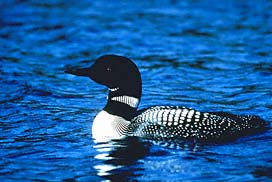
Description: Referred to as the "spirit of northern waters", the common loon is recognized as a symbol of unspoiled wilderness. In breeding plumage, this water bird is black-headed with a heavy, black, dagger-like bill, dark red eyes, a black collar, a white necklace, prominent white checks on the back, and white underparts. In non-breeding plumage, the body is essentially grayish above and whitish below with varying amounts of white showing on the side of the head. Dark traces of the collar are often visible. In the winter, the bill is lighter and of a grayish hue. Juveniles are similar to adults in winter plumage, but have more prominent barring across the back. A distinctive feature of the loon is its eerie, yodel-like call that can be heard on northern lakes where nesting occurs and on wintering areas in late winter and early spring.
Life History: Returning to the same breeding grounds year after year, common loons are believed to mate for life. Upon their return, the pair renews their bond with short displays, including synchronized swimming, head posturing and diving. The nest is built within a few feet of the water's edge by both the male and female. A clutch of two eggs is laid sometime between mid-May and June. The young hatch after an incubation period of 26-31 days and begin to swim almost at once. Within 24 hours, they are moved by the parents to a nursery area away from the nest. In 2-3 weeks, the young are able to make short dives and catch small fish. Fledging occurs in 11-13 weeks. Juveniles may spend several years in oceanic wintering areas before returning inland to breed. The loon's diet consists almost entirely of fish.
Habitat Associations: Breeds on lakes and ponds. Nests are built on islands, lakeshores and marshes or bogs. Winters on the ocean from Maine to Florida, sometimes congregating on inland lakes before migrating.
Protection Strategy:
- Maintain water quality through shoreline buffer protection and other measures.
- Support efforts to prevent disturbance at nest sites.
- Promote public awareness of the change in regulations limiting the use of lead sinkers.
- Contact the Loon Preservation Committee for more detailed information on protecting individual nest sites and maintaining water levels conducive to successful loon nesting on dam-controlled water bodies.
Great Blue Heron
© Brian E. Small
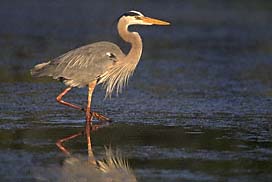
Description: The great blue heron is the largest heron in North America. It stands 3-4 feet tall and has a wingspan of almost 6 feet. It has blue-gray feathers on most of its body and a plume of feathers on its chest and back. It has a long, pointed yellow bill and long legs. Adults have white on the top of their heads and long black plumes above their eyes.
Life History: The female great blue heron lays 3-7 eggs on a shallow platform made of sticks and twigs and lined with soft material. The nest is usually in a tall tree, but it may be built in the reeds or on a cliff edge. The eggs hatch in about a month and the chicks will fledge when they are about two months old. Great blue herons nest in colonies. They usually nest in the same spot from year to year. They may even use the same nest. The great blue heron migrates in the fall, although some stay in the northern part of their range. The great blue heron usually tucks its head into an S-shape when it is resting and flying.
Habitat Associations: Great blue herons usually nest in colonies although single nests are occasionally found. Rookeries may be as large as several hundred nests, but the largest in New Hampshire contains about 125 nests and the average colony is about 15 nests. Preferred nesting sites are remote islands or inaccessible swamps. Nests in New Hampshire are most commonly places in the upper limbs of dead trees, often white pine and red maple, in active beaver ponds.
Protection Strategy: Rookeries are usually returned to year after year, although sites are occasionally abandoned. Human disturbance during breeding is one cause of abandonment. Protection efforts should include maintaining a visual buffer between nests and houses or other human activity. This can be achieved by natural land formations or obstructions such as trees. The barrier must be effective when the leaves are off the trees because breeding activity begins before leaves appear. Educate those near nesting sites regarding the sensitivity of herons to disturbance. Limit visitation close to the colonies from March through at least 1 June. If herons are nesting in active beaver ponds, consider protecting the entire wetlands complex. Beavers abandon a pond after their food has run out and move nearby, creating a variety of ponds in various stages of flooding. This natural succession provides quality nesting and feeding habitat for great blue herons. By protecting the wetland complex, it allows enough space for this natural beaver cycle to take place. In addition to protection of rookeries, the protection of shorelines, riparian areas and both coastal and inland wetlands is critical to maintaining feeding areas for great blue herons, whose primary food is fish.
Barren Strawberry
Waldsteinia fragarioides
© Janet Novak
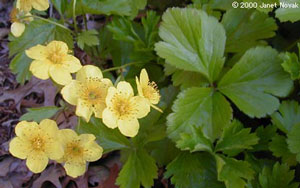
A low-growing perennial herb having strawberrylike leaves, yellow flowers and small, dry, inedible fruit.
- Family: Rose (Rosaceae)
- Habitat: woods, clearings
- Height: 3-8 inches
- Flower size: 1/2 to 3/4 inch across
- Flower color: yellow
- Flowering time: April to June
- Origin: native
Featherfoil
Hottonia inflata
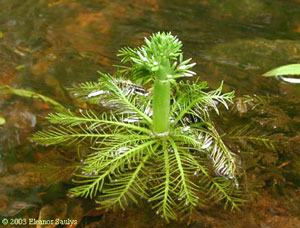
© Eleanor Saulys
Featherfoil is an aquatic plant, with submerged, feathery leaves and an inflated flower stalk that rises above the water.
- Family: Primrose (Primulaceae)
- Habitat: shallow water in ponds and slow streams
- Height: 2-6 inches above the surface of the water
- Flower size: 1/8 inch across
- Flower color: white
- Flowering time: May to August
- Origin: native
Prostrate Tick Trefoil
Desmodium rotundifolium
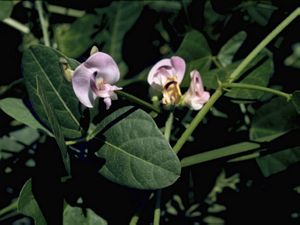
This plant trails along the ground in dry woodlands and is characterized by its round leaves; the flowers are pea-like. Its seedpods are segmented and the hairy seeds are carried to other locations by sticking to animals.
Slender Blueflag Iris
Iris prismatica
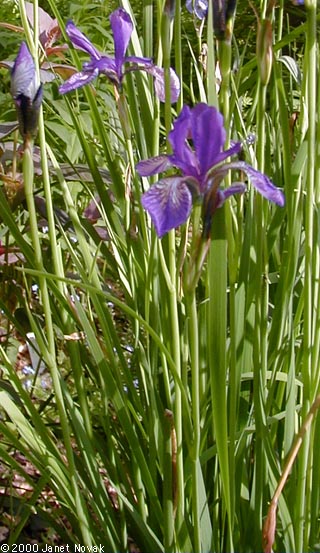
© Janet Novak
This species looks similar to the larger blueflag. They can be distinguished by the width of the leaves. Slender blueflag leaves look almost like grass (they are less than 1/4 inch wide); larger blueflag leaves are a half to one inch wide.
- Family: Iris (Iridaceae)
- Habitat: marshes (fresh, brackish, or salt), shores, or meadows along the coast
- Height: 1-3 feet
- Flower size: 2.5 to 4 inches
- Flower color: blue-purple
- Flowering time: May to july
- Origin: native
Some content on this page taken from Identifying and Protecting New Hampshire's Significant Wildlife Habitat: A Guide for Towns and Conservation Groups, by John Kanter, Rebecca Suomala and Ellen Snyder.